About ReadSpeaker
With 25 years of expertise, ReadSpeaker’s text-to-speech solutions and voice-enhanced learning tools help make content accessible and engaging for a diverse population of learners. Integrated directly in learning platforms, or as an individual tool, ReadSpeaker provides easy-to-access and easy-to-use text to speech for any content, on any device, including assessments, assignments, STEM, OCR and quizzes. ReadSpeaker has 200+ voices in 50+ languages, and is working with 12000+ customers in over 70 countries.
A guest blog for Enovation by ReadSpeaker
Effective digital learning across educational institutions and professional organisations has become ever-more vital to meet the many changing needs of learners in recent years. It also means that providers face increasing pressure to do more than just deliver learning content.
They are expected to support equitable access, measurable outcomes, and consistent engagement across highly diverse audiences, including disabled, neurodiverse, visually-impaired, second-language, and time-poor learners (such as adults working and juggling childcare responsibilities).
This is reshaping the core architecture of today’s learning environments. Accessibility is no longer a compliance layer added at the end. It has become central to learning performance.
To a great degree, it is actually easier to build accessibility into learning platforms from the start, rather than attempting to set up numerous individual accommodations afterwards.
But there is another reason why accessibility by design is so important: it drives performance. By taking the right approach to inclusivity in education, educators improve engagement, completion rates, and learning outcomes for all.
The European Accessibility Act and its wider impact
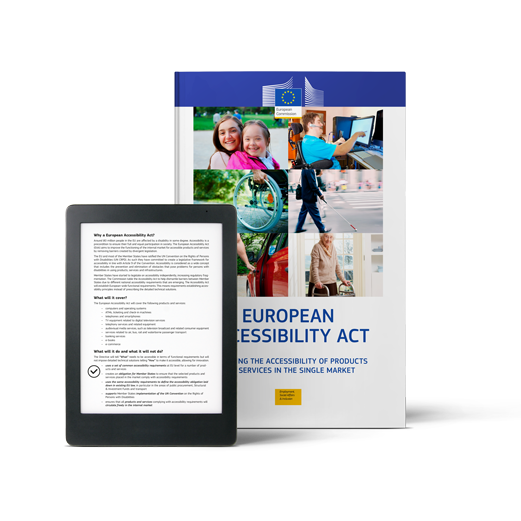
The European Accessibility Act (EAA), now in force across EU member states, is accelerating this shift in focus. While the EAA reinforces the importance of accessible digital learning platforms, its broader impact is more structural: it promotes a universal design approach, focused on removing and preventing barriers from the outset.
POUR Principles
In practice, the EAA raises the baseline expectation for digital accessibility across education and enterprise systems. Its requirements align closely with WCAG 2.1 Level AA standards, meaning digital learning experiences must be:
- Perceivable: Content must be available in ways users can sense, often through multiple formats
- Operable: Interfaces must be usable through different interaction methods, including keyboard navigation
- Understandable: Information must be presented clearly for a wide range of users
- Robust: Content must remain compatible with assistive technologies and evolving digital environments
For organisations, this effectively sets accessibility as a default requirement rather than a differentiator.
But regulation alone doesn’t explain the direction of travel.
Learning accessibility: From compliance pressure to design strategy
Alongside regulatory change, education providers and learning organisations are already rethinking how accessibility is implemented, driven as much by operational reality as by compliance.
A reactive, compliance-led approach, where accessibility is applied late in the design process, creates two persistent challenges:
- Administrative complexity, with ongoing accommodation requests and fragmented solutions
- Limited visibility into impact, making it difficult to measure how accessibility affects engagement, comprehension, and completion
As learning environments scale across platforms, formats, and user groups, these challenges become harder to manage.
This is why many organisations are shifting towards inclusive design as a system-level approach. Rather than adapting content after the fact, inclusive design assumes variability from the start. Accessibility becomes part of how learning is delivered, not an exception to it.
This shift reframes accessibility from a compliance task to a performance question:
- How do we reduce barriers to understanding?
- How do we support different cognitive and sensory needs?
- How do we enable learning across contexts, on demand, on the move, and across devices?
- How do we deliver consistent outcomes at scale?
In this model, regulation like the EAA doesn’t sit apart from strategy, it accelerates a vital transition that is ultimately about performance: designing learning systems that work for real learners, not idealised ones.
Integration as the enabler
ReadSpeaker’s partnership with Enovation harnesses this deep shift, enabling Text to Speech (TTS) technology to be embedded directly into Moodle and Totara learning management system (LMS) environments as part of a unified learning experience focused on inclusivity.
TTS makes accessibility consistently available, easy to use, and part of the natural learning flow. Because in practice, accessibility only delivers value when learners can use it without friction.
This matters even more when viewed against the research. A growing body of evidence shows that accessibility tools, particularly TTS and multimodal learning approaches, benefit a far wider population than originally assumed.
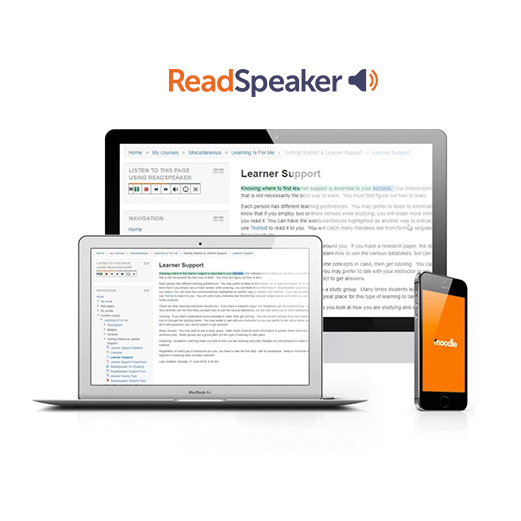
Studies across multiple universities, for example, demonstrate improvements in both comprehension and retention when learners can combine reading with audio. The reason is straightforward: multimodal learning reduces cognitive load. Instead of focusing effort on decoding text, learners can concentrate on meaning, structure, and analysis.
This has obvious relevance for higher education, where learners typically need to engage with dense academic material. But the same dynamics apply across sectors: in corporate environments, for example, where learning needs to accommodate workload pressure, and scale across often global, multilingual populations; and in vocational environments, such as healthcare, where learning needs to be delivered quickly, updated frequently, and applied immediately in real-world jobs.
In all of these learning environments, content that relies on static text creates uneven outcomes, as it doesn’t allow for the different ways learners engage depending on language proficiency, cognitive preference, and environment.
Greater understanding of these dynamics is resulting in accessibility becoming part of core learning strategy — not as an accommodation layer, but as a way to improve consistency, engagement, and performance at scale.
Why integration matters as much as capability
A key lesson across sectors is that accessibility only works when it is embedded into existing workflows. Standalone tools rarely scale. When learners or staff need to adopt additional platforms, download extensions, or change behaviour, usage drops, regardless of the tool’s potential value.
This is why organisations are increasingly prioritising accessibility that sits directly within LMS environments. Within these systems, accessibility can become part of the learning experience itself — available at the point of need, across all content, without additional effort.
This is where ReadSpeaker and Enovation’s partnership is critical. Together we can ensure the right technology is in place to ensure accessibility is available by default across the entire learning environment — consistent, scalable, and aligned with how organisations already deliver learning.
Inclusive design as a performance strategy
When accessibility technology like TTS is embedded in this way into digital learning environments:
- Learner engagement becomes more consistent
- Comprehension improves across diverse groups
- Administrative burden decreases
- Completion rates increase
- Learning becomes more equitable and scalable
The most significant shift is conceptual. Accessibility is no longer about supporting a subset of learners. It is about designing systems that reflect how learning actually happens in real-world conditions (a theme we also discussed in our recent joint webinar on neurodiversity and accessibility).
Conclusion: Designing for real learners, not ideal ones
Inclusive design starts with a simple premise: learners are not uniform. When accessibility is embedded into the learning experience, outcomes improve for everyone.
The challenge now is not whether accessibility should be implemented, but how to deliver it consistently at scale, across an increasingly complex learning landscape. That is where integration, platform design, and partnerships like ReadSpeaker and Enovation play a defining role.
Not because accessibility is required. But because it works.
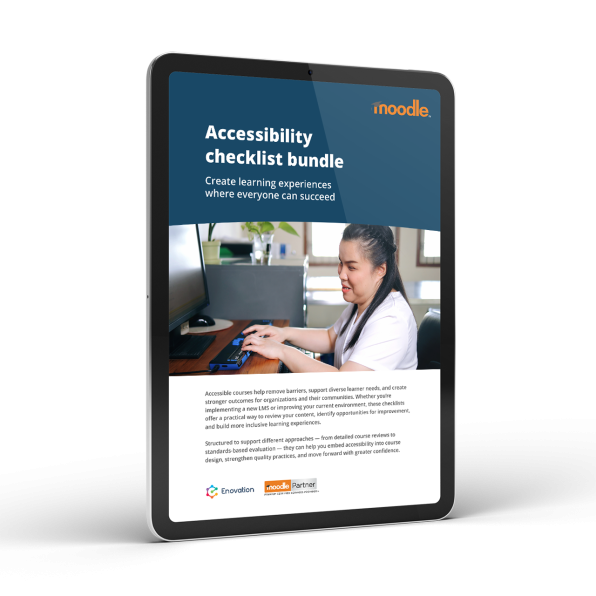
- DOWNLOAD OUR ACCESSIBILITY CHECKLIST to help you create more inclusive digital learning experiences for everyone.